
TOMODACHI SMBC Shaka-kachi Leadership Program: In-Person and Online Sessions Begin

From October to December 2025, the TOMODACHI SMBC Shaka-kachi Leadership Program held its Social Value Creation Training and leadership workshops. Designed for university students who are eager to address social issues and take concrete action, the program aims to cultivate the next generation of leaders who will drive positive societal change with a global mindset. Throughout the program, SMBC Group employees serve as navigators, providing guidance and support to participants. Over the course of approximately six months—from October onward—the program includes an in-person Social Value Creation Training, online leadership workshops, multiple individual meetings with navigators, a U.S. training, and a final presentation.
On October 6, 2025, the first Social Value Creation Training was held in Tokyo, bringing together participants from all over Japan. In addition to receiving an orientation on the program, participants learned about the business initiatives of the SMBC Group. A panel discussion was also held with four representatives from the SMBC Group, where the participants were introduced to concrete examples of social value creation initiatives and gained valuable insights related to their own career development.
From October to December, participants took part in online leadership workshops. Through these sessions, they explored their own leadership traits, learned about the strengths of other participants and their navigators, and reflected on how teams can leverage diverse leadership styles. Furthermore, after each leadership training, follow-up meetings are held for each group. This allows participants to move beyond simply learning concepts and instead practice leadership through real dialogue within their teams.
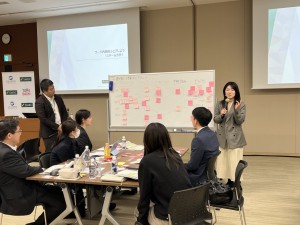 At the in-person Social Value Creation Training held on December 8, participants learned about the Logic Model as a tool to develop and strengthen their individual projects. They practiced applying the Logic Model to familiar examples to examine the logical cause-and-effect relationships that connect activities to impact. In addition, a TOMODACHI alumnus joined as a guest speaker to share his journey since participating in a TOMODACHI program and to speak about their current work, followed by a Q&A session.
One participant, Daiki Shiraishi, shared the following reflection on the workshop:
“Through the Logic Model workshop, I realized how challenging it is to work backward from the ultimate goal, or ‘impact,’ and translate that into concrete ‘activities.’ I especially learned how much more analytical thinking is required to logically connect ideals and interventions through clear causal pathways. That said, I’ve already taken the first step by drafting an initial version of the Logic Model [for my own project]. I plan to continue refining it by incorporating feedback from my team members and other stakeholders so that it evolves into a strong, highly actionable model.”
As the program enters its latter half, the participants continue to deepen their understanding of leadership and further develop their project ideas through the training sessions, and will take part in the U.S. training scheduled from February to March.