TOMODACHI Alumni Highlight Series – Kiina Wakiyama
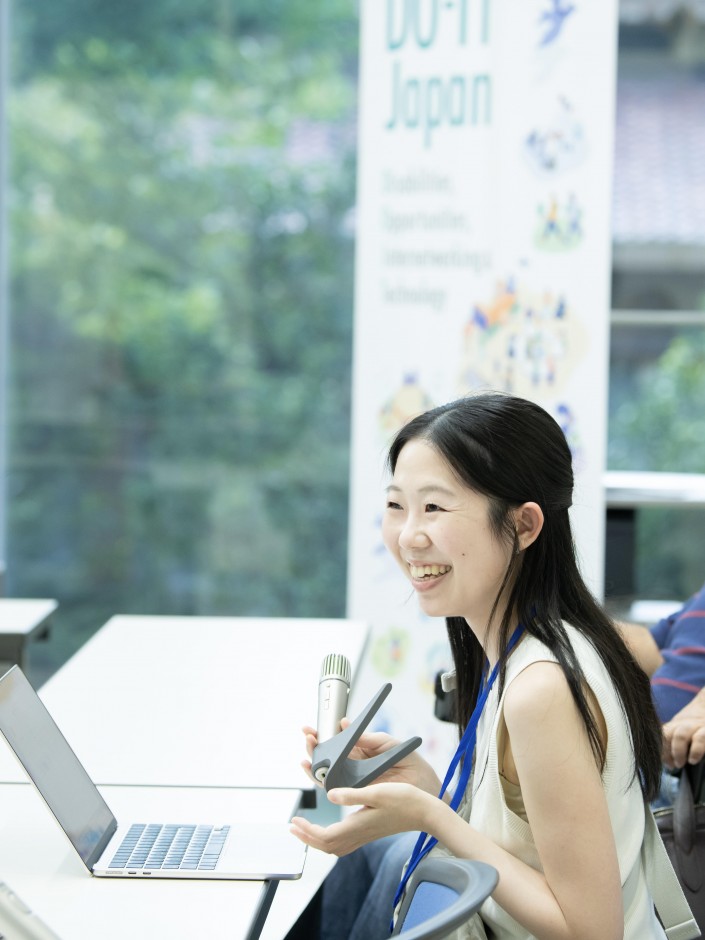
Kiina Wakiyama is involved in the management of DO-IT Japan, a leadership program for young people with disabilities and chronic illnesses, run by the Social Inclusion Systems research group at the Research Center for Advanced Science and Technology (RCAST), the University of Tokyo. Kiina is passionate about advocating for the rights of people with diverse characteristics and needs to live authentically in society, and about walking alongside them as they pursue what they want to challenge and achieve.
Kiina developed a severe neurological illness during high school and has since faced numerous social barriers in pursuing further education, employment, and various forms of social participation. Hoping to foster broader empathy and understanding of the realities of living with a disability, she participated in the 2022 TOMODACHI Story Jam for Youth with Disabilities program.
Can you tell us about your experience with TOMODACHI Story Jam for Youth with Disabilities?
In 2022, I participated in TOMODACHI Story Jam for Youth with Disabilities while attending college. After experiencing a rare neurological disease during my second year of high school, I became interested in the surrounding environment of people with disabilities and illnesses, and decided to focus my studies and research the field in college.
Throughout college, I’ve always wanted to challenge myself and go abroad, so I became interested in the TOMODACHI program. Initially, I planned to apply to Boston’s training program but due to COVID-19, I switched to Story Jam. Though I originally knew someone in the Boston training program, I decided to participate in Story Jam because I thought it would be a good opportunity.
Do you have any special memories that you still think back on from participating in the TOMODACHI program?
Story Jam was implemented online since travel and in-person interactions were restricted due to COVID-19. However, even with those restrictions, what left a strong impression on me was that despite the physical distance, we were able to come together under the common theme of “disability” and learn from each other while feeling a sense of connection.
How do you think your experience with TOMODACHI Story Jam for Youth with Disabilities has impacted your personal growth?
For the first time through Story Jam, I challenged myself in storytelling by narrating my own experiences as a “story”. Reflecting on the past, challenges we currently face are never easy, but the process of listening to my own heart and reweaving thoughts I swallowed and never put into words became a big opportunity to consider “what kind of future do you want to live from now on.”
Moreover, as I engaged with the other participants’ stories, I strongly felt that the words and voices born from each of their experiences, even without embellishments, were powerful and touched people to their core. By reflecting on myself and listening to the voices of others, I was able to realize, “what is normal to oneself is not always correct.” I believe this experience was an important turning point that made me want to approach others with an open mind and compassion.
Please tell us about your current work with DO-IT Japan?
I am currently involved in the management of the leadership program, DO-IT Japan, focusing on children and young people with disabilities and illnesses in the Social Inclusion Systems Division at the University of Tokyo’s Research Center of Advanced Science and Technology. In this program, we support each participant’s learning and movement style that best suits their needs, with a specific focus on technology. Moreover, it is also important to think and practice with participants ways to expand an inclusive environment within society through individual efforts.
Since getting involved in this field as a professional, have there been any changes or increases in your own awareness of issues and challenges?
In Japan, the legal system regarding disabled people’s rights has significantly developed in recent years, and I can feel the environment surrounding people with diverse characteristics or needs has been changing. On the other hand, through daily projects, when meeting high school and university students, seeing young people aim for employment, and the schools or workplaces they belong to, I feel there is still a significant gap in information on accepting and including those with disabilities.
Originally, I had a strong interest in the social gaze directed toward people with disabilities and the structure in which they are perceived as “an existence different from the majority in society.” Through my experience with TOMODACHI, while acknowledging that legal systems, schools, corporations, and society have responsibilities, I’ve come to believe the most important thing is an individual’s voice.
New empathy is born from individual stories, and a “personal truth” is shaped between that person and their environment, little-by-little. In the field I’m involved in, I feel that storytelling can continue to be a major breakthrough in supporting that process.
Please tell us about your participation in INDEX (International Youth Development Exchange).
INDEX (International Youth Development Exchange Program) is a government program, and I visited France with seven other delegates representing Japanese youth. We observed the accessibility of facilities that were built or renovated for the Paris 2024 Olympic and Paralympic Games. I am currently working in the field of disability inclusion and manage a leadership program for youth with disabilities in Japan. Accessibility has always been one of my interests, so I decided to apply for the program.
Through the program, we exchanged insights and knowledge from the legacies of both Tokyo 2020 and Paris 2024, with the aim of developing innovative solutions for barrier-free and universal design. What left the strongest impression on me was a Parisian urban planning initiative known as QAA. In the model districts promoting enhanced accessibility, public facilities had been made barrier-free, and accessible signage was well developed. Moreover, beyond the physical and visible aspects, I was deeply inspired by the tolerance toward diversity among local residents and by their willingness to support others who need assistance without hesitation.
Now, I am determined to contribute to the advancement of barrier-free and universal design as a next-generation global leader.
In the coming years, or the next 10 years, do you have any dreams or goals you would like to share?
Since university, I have studied fields related to my own experiences, and presently continue to work with people with disabilities or illness because I have had numerous experiences that left me feeling dissatisfied. When considering the future society, I strongly wish for an environment where disabled people can receive the same options and opportunities as others.
To achieve that, I want to continue exploring roles and ways of working while questioning how I can leverage my experiences to support someone who needs me. At the same time, my personal goal for the future is to be involved in society in the long term while placing myself in an environment where I can continue to grow.
Finally, could you give a message to young people who are either facing disabilities themselves or are considering learning more about this field?
Even when using the terms “disability” and “illness”, each person’s experience is entirely different, and I believe everyone has their own special story. In recent years, there has been an increase in positive words and ways of thinking, but many people are still facing difficult obstacles. What I want to convey most to those facing disabilities or illness is that “the meaning you assign to your disability and illness is only something you can determine.” There is no need to have judgments like good or bad, positive or negative, imposed on you by others.
Moreover, for young people aiming to work in the field of Disability Inclusion, I believe this area can often seem confusing and challenging. However, it is also a world worth sincerely engaging with. I hope for a network where people with diverse motivations and concerns gather to engage in dialogue, learn from one another, and continue to expand.
In recent years, while I feel that blatant discrimination is decreasing, the emotional distance stemming from the hesitation of “not knowing how to act with people with disabilities” still exists widely in society today. The word “disability” tends to be received with a sense of tension, but instead of focusing on the presence or absence of a disability, I think it is important to face the relationship of “you and me” or “self and others,” respect each other, learn, and empathize with each other sincerely about what we do not know. By nurturing these relationships, a society that understands individual “authenticity,” not limited to disabilities, may be created.
This alumni highlight interview was conducted by Kaz Ozawa on December 23, 2025 and translated by Camille Nikaido. Kaz and Camille are currently an alumni intern with the TOMODACHI Alumni Leadership Program.